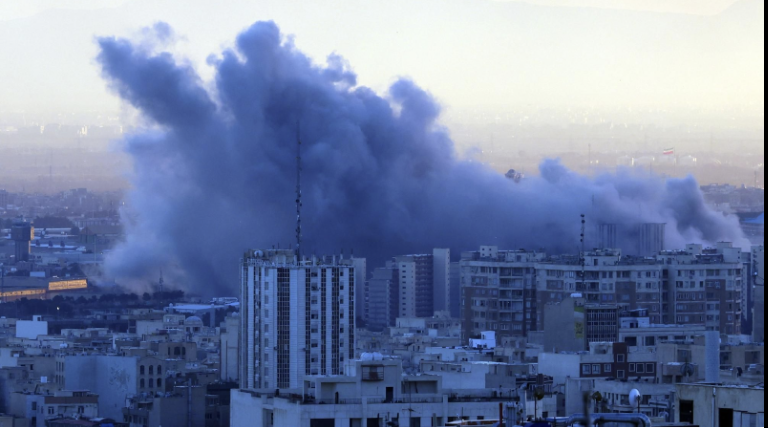
On Saturday, Feb. 28, President Donald Trump released an eight-minute video on Truth Social justifying major U.S. military combat operations in Iran. In the statement recorded at his Mar-a-Lago resort in Florida, the President stressed that these attacks were carried out due to the contentious and often violent history between the U.S. and Iran. Since 1953, American presidents have remained involved with Iran, but President Trump’s aggression is an unprecedented escalation.
Ali Khamenei, the supreme leader of Iran, was confirmed dead by Iranian officials on March 1. Initial strikes were launched by Israel against Tehran early Saturday morning (eastern time) before the U.S. joined, leading to Iran’s quick retaliation toward Israel and several U.S. military bases in the Middle East.
Israeli and American aims are nothing new; according to President Trump, “Our objective is to defend the American people by eliminating imminent threats from the Iranian regime, a vicious group of very hard, terrible people”.
Both nations have publicly restated decade-old intentions to dismantle Iran’s nuclear capabilities, despite the fact that U.S. intelligence assessments consistently demonstrate Iran is not close to developing advanced weaponry.
Although congressional authorization has not been granted, both U.S. and Israeli aggression is expected to continue. Trump administration officials have not provided definitive information that would suggest a resolution.
Democratic lawmakers have already spoken out, urging their Republican colleagues to reach across the aisle and vote for a war powers resolution that would require Trump to gain congressional approval for further military action. The resolution has been narrowly rejected by House and Senate Republicans.
According to an NBC News poll, a 52% majority of Americans do not support U.S. intervention in Iran. Despite Trump’s insistence, the United States has little strategic reason for spending billions on entering another Middle Eastern conflict, particularly when domestic challenges at home remain unsolved.
Following 9/11, decades of conflict in Iraq and Afghanistan left thousands of American service members dead, trillions spent, and no promise of stability in the region. Trump can (and will) deliver as many strongly-worded speeches to the public claiming his war will protect the country as he wants; the collective American memory is not too poor to forget the Bush and Obama presidencies. As early polling suggests, endless war – which Trump campaigned against in 2024 – is no longer appealing to the country.
At the same time, the United States faces urgent problems at home that demand political attention. Instead of spending hours on the House floor debating how long intervention should last, many Americans believe that policymakers should focus on the affordability crisis, which will certainly be a hot topic in the upcoming midterm election cycle.
The current escalation reflects a longstanding dynamic in which Israel seeks greater American involvement in Iran. For decades, Israeli leaders have warned that Iran is an existential threat and have repeatedly pressured Washington to take a more aggressive stance. Prime Minister Benjamin Netanyahu is one of many who have argued that Iran’s nuclear ambitions justify preemptive force.
While Israel’s security concerns are not unjustified, its expansionist and territorial mindset in the Middle East should not dictate American foreign policy; why are our troops being endangered for the interests of a foreign country? U.S. national interests and public consent should take precedence over the strategic priorities of an allied government seeking to resolve its own geopolitical disputes.
On Sunday, Prime Minister Netanyahu publicly celebrated the trajectory of the war, stating, “This coalition of forces allows us to do what I have yearned to do for 40 years… This is what I promised, and this is what we shall do.”
According to Politico, the Pentagon is preparing for a prolonged war with Iran alongside Israel, sending reinforcements that could support operations until September. In past conflicts, military operations of this size have been planned months in advance. The Pentagon’s rapid action signals a lack of U.S. preparation for the scale of this war.
On Wednesday, Defense Secretary Pete Hegseth stated that airstrikes against Iran will escalate, delivering “death and destruction from the sky all day long”. So far, the Pentagon has declared six American troops killed in action. According to the Human Rights Activists News Agency (HRANA), over 1,000 civilians have been killed in Iran since the beginning of the attacks. This includes 181 children below the age of 10.